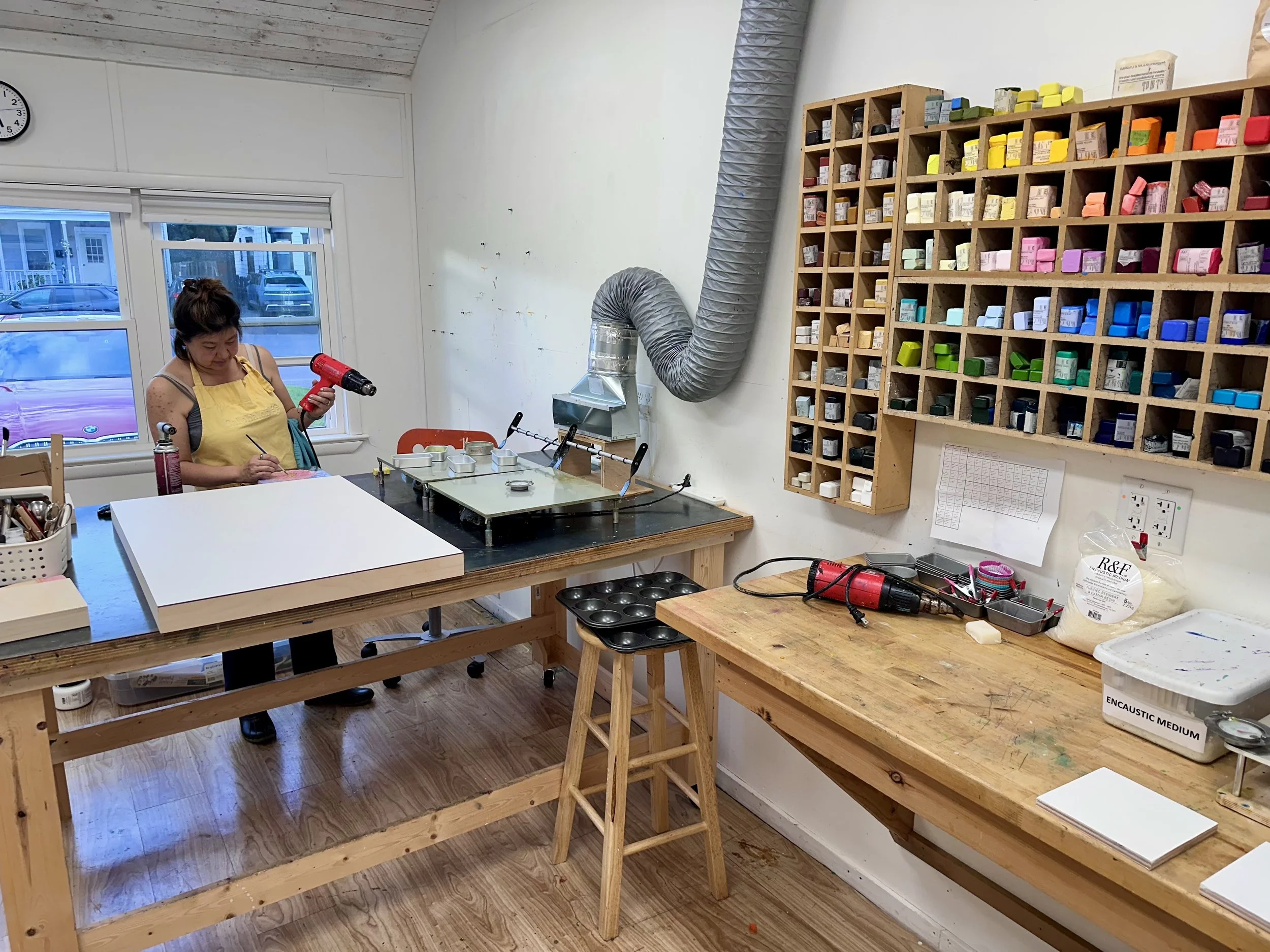
What is encaustic painting?
Encaustic painting brings together wax, pigment, and heat. Layers of colored beeswax are applied and fused, creating surfaces that can be translucent, smooth, or richly textured. The wax can be scraped, carved, and reworked, revealing traces of what came before.
The medium has roots in ancient Greece and survives in the remarkable portrait paintings of Roman Egypt. Today, artists continue to explore its possibilities through painting, collage, and sculptural forms.
Who are well-known or famous artists who use encaustic painting?
Jasper Johns used encaustic (pigment mixed with melted wax) to give everyday images such as flags, targets, numbers, and maps a richly textured surface.
In Flag (1954–55), Johns combined encaustic, oil paint, and collage, incorporating strips of cloth and newspaper into the wax. The materials and marks of making remain visible within the finished painting.
In Target with Four Faces (1955), Johns built up the target’s concentric circles with wax over collage, making their surface tactile and irregular. These works invite us to recognize a familiar symbol while also looking closely at the painting as a physical object.
Encaustic remained part of Johns’s practice for decades. In Between the Clock and the Bed (1981), he used the medium to create layers of colored crosshatching across three panels.
His paintings show encaustic’s versatility: it can hold fragments of everyday life, preserve the artist’s marks, and build complex surfaces through layers of color.
What is the history of encaustic painting?
Encaustic painting, which uses pigment mixed with wax, was used in ancient Greece. The best surviving examples include the Fayum mummy portraits, painted in Roman Egypt during the first through third centuries CE. Encaustic techniques continued in early Byzantine religious icons.
Is encaustic paint durable?
Yes! Encaustic paintings are durable when properly made and cared for. Although encaustic paint includes wax, it also includes damar resin, which hardens the beeswax and raises its melting point.
How do I care for an encaustic painting?
Display them at normal indoor temperatures, away from direct sunlight and heat sources, and avoid extreme heat or freezing conditions during storage and transport.
What are resources for encaustic painters?
I’ve found these organizations to be helpful. I like that R&F Paints offers the Brown Pink House – a two-bedroom house in Kingston, NY, that comes with a fully stocked studio. It is a great place to do an artist residency.
Museum and Artist Organizations
Museum of Encaustic Art
Located near Santa Fe, New Mexico, the museum shows wax-based artwork including painting, photography, mixed media, and sculpture. The website also offers access to collections and educational programs.
International Encaustic Artists
I have attended their conferences on Cape Cod in Massachusetts. It is an international organization. Lots of resources on their website, including: chapter information, exhibitions, grants, mentoring, and Wax Fusion, a publication featuring artists and techniques. They also have online events.
Encaustic Art Institute
The nonprofit organization behind the Museum of Encaustic Art offers workshops, juried exhibitions, an online member gallery, and opportunities to explore contemporary encaustic work.
Encaustic Paint Manufacturers
R&F Handmade Paints
I use mostly paints from R&F. They sell mediums, tools, starter kits, and offer some educational resources. The website includes technical guidance, artist articles, and information about studio practices. If you visit the Brown Pink house, you can visit their office and factory. It is 2 blocks away.
Enkaustikos
A Rochester, New York, manufacturer of encaustic paints made with beeswax, damar resin, and artist pigments. Its range includes Hot Cakes, Hot Sticks, mediums, brushes, and tools, alongside color and materials information.
About Encaustic Art